Choose Embroidery Floss for Friendship Bracelets
For a friendship bracelet, buy six-strand cotton embroidery floss and use all six strands together as each string. Choose colours with enough contrast to see the pattern, then estimate length from the knotted length, knots, start and ties, and extra allowance. A skein holds 8 m, but the amount you need depends on the pattern and each string’s job.
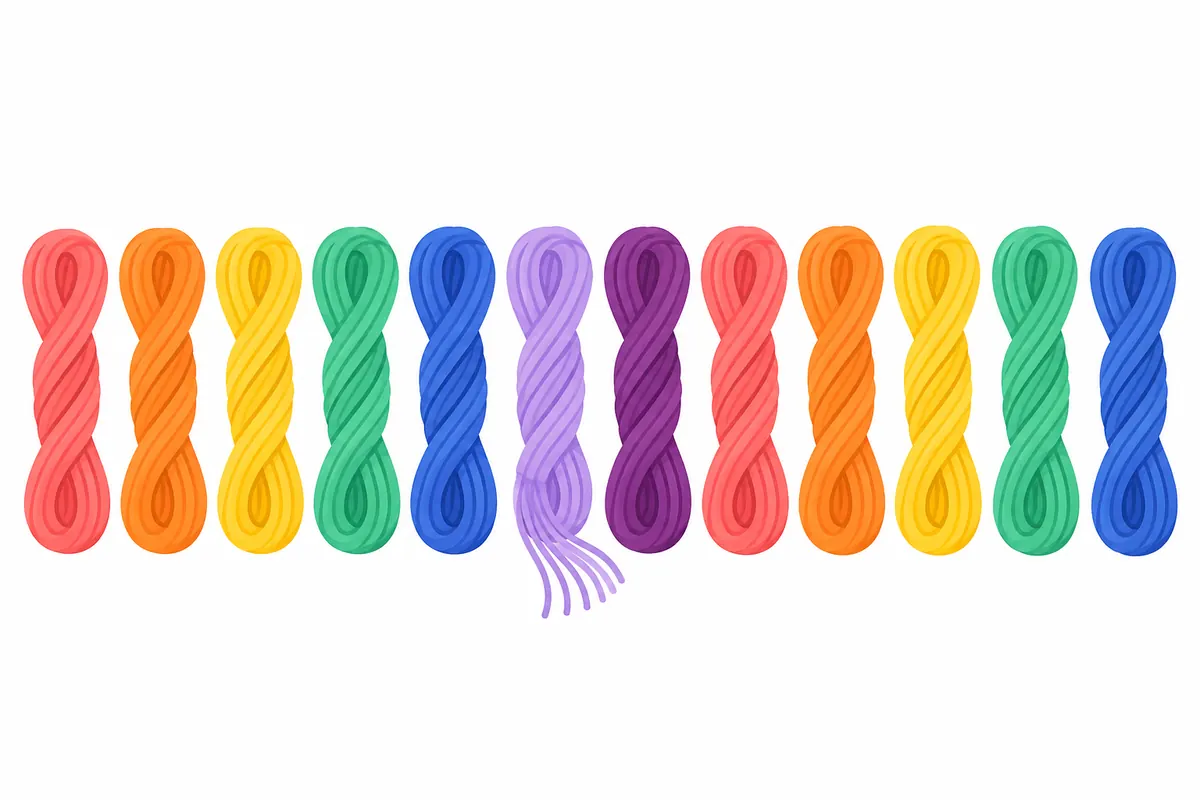
Choose the right embroidery floss
Look for embroidery floss (six-strand) made of cotton. It is the usual string for friendship bracelets. Keep all six strands together when you cut a string; do not separate them into thinner strands. That gives you the usual thickness for tying knots and makes the pattern easier to handle.
Floss comes in a skein. A skein of six-strand embroidery floss (DMC article 117) holds 8 m. You can use the same colour for several strings, but count the length needed for each string before you decide how many skeins to buy. If a colour is used for several long strings, add those lengths together.
Pick colours that show the pattern
Start with two colours that have strong contrast. A light colour next to a dark one makes the knots and pattern easier to follow while you work. This is especially helpful when you are learning which string to move and where to tie each knot.
For chevrons and diamonds, place a light and a dark colour next to each other so the shape stands out. You can use more colours, but check that neighbouring colours still look different enough to read. Colours on screens are approximations of the real floss, so the skein may look different in person.
Floss colours are sold by number. The maker lists 489 DMC colour numbers and shows how much of each you need for a pattern. Use the numbers to identify the colours you want, then check the actual floss before you start if the precise shade matters to you.
Estimate how much floss to cut
Begin with the knotted length: the finished length of the bracelet section made from knots. Each knot uses about 1.5 cm of the string that ties it, so a string that ties many knots needs more length than one that ties only a few. The number of strings alone does not tell you how much each one needs.
For a quick estimate, a normal pattern grows about 0.2 cm per row and an alpha pattern about 0.25 cm per row. Add 10 cm at each end for the start and ties, then about 15% extra. These are estimates; different strings in the same pattern can use different amounts, especially when some make many knots and others make few.
For a candy stripe with 4 strings and a 16 cm knotted part, plan about 90 cm per string. For a classic chevron with 8 strings and a 16 cm knotted part, plan about 95 cm per string. Use these as pattern-specific examples, not a single rule for every bracelet.
Plan strings for an alpha pattern
An alpha pattern has base strings that run along the bracelet and knotting strings that make the design. The base strings hold the width; the knotting strings travel across the rows and can use much more floss. Plan their lengths separately instead of cutting every string to the same size.
For an alpha name bracelet 7 strings wide and 16 cm long, use 7 base strings of about 45 cm. The knotting strings add up to several metres, tied in pieces of about 150 cm. You can join another piece when one runs short, so you do not need to handle one very long knotting string at once.
If you are unsure how much a particular colour needs, use the pattern’s string amounts where available. Keep the strings in their left-to-right order as they hang at the start: A, B, C, and onward. That makes it easier to match each string to its role as you knot.
Cut and set up your floss
Write down each colour and the length you plan to cut before you open or cut the skeins. Add together the amounts for strings that use the same colour. Keep the about allowance in mind: the estimates include room for the start and ties, but your knots may use a little more or less floss.
Cut the strings, then arrange them in the pattern’s starting order from left to right. Secure the starting ends so the strings stay in place while you work. Check the colour order and that each string can reach the area where it needs to make knots before you begin.
If a string gets short, stop before it is too short to tie comfortably. For an alpha pattern, add another knotting piece of about 150 cm as needed. For other patterns, leave enough length to finish the remaining knots and tie the ends.
Questions
What kind of floss should I use for friendship bracelets?
Use six-strand cotton embroidery floss. Keep all six strands together as one string for the usual bracelet thickness. A skein of DMC article 117 holds 8 m.
How much floss do I need for a friendship bracelet?
It depends on the pattern and how many knots each string ties. Estimate from the knotted length, add 10 cm at each end for the start and ties, then about 15% extra. Each knot uses about 1.5 cm of the string that ties it.
How many metres are in a skein of embroidery floss?
One skein of six-strand floss is 8 m long (DMC sells article 117 in that size). Add up the estimated lengths of all strings in one colour, then divide by 8 m to see how many skeins of that colour you need.
How do I choose colours for a friendship bracelet?
Choose two colours with strong contrast so the pattern is easy to read. For chevrons and diamonds, put a light and dark colour next to each other. Screen colours only approximate the real floss.